Agencies and how the K-pop industry works
20 common questions on this topic, answered.
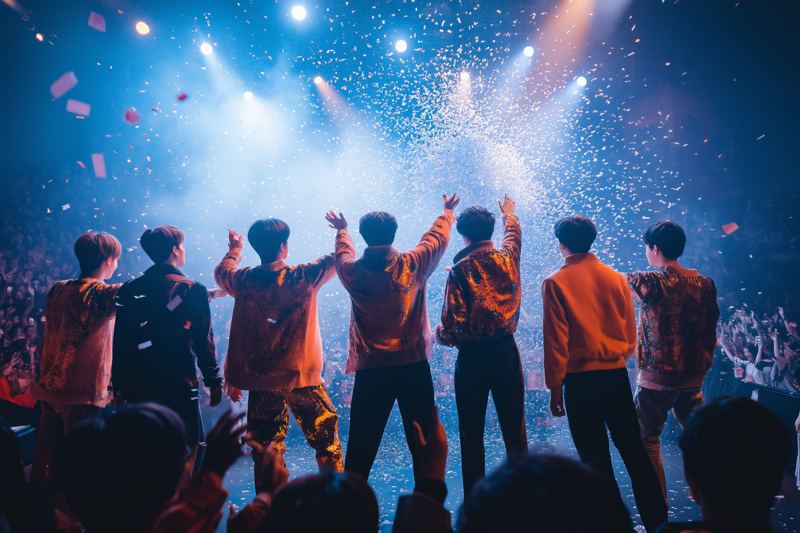
Illustrative image
Q&A
20 questionsCHECKED
Fact-checkedUPDATED
2026-11-1501What does a K-pop agency actually do?
A K-pop agency finds and trains artists, debuts them, and then manages nearly everything they do: albums, concerts, TV appearances, endorsements and merchandise. Koreans often call these companies entertainment companies or simply the artist's label. A key difference from many Western markets is that one company usually handles both music production and day-to-day management under the same roof.
02Which are the biggest K-pop agencies?
HYBE, SM Entertainment, JYP Entertainment and YG Entertainment are the names most often described as the major agencies. Other large players include Kakao Entertainment and companies under the CJ ENM group, each managing several acts. Rankings shift from year to year with sales and concert revenue, so it is better to see them as a group of leading companies rather than a fixed order.
03What is a K-pop trainee?
A trainee is an aspiring artist who signs with an agency and trains toward debut in singing, dance, languages and stage presence. Trainees go through regular internal evaluations, and some are placed in a debut lineup while others leave when their contract ends. Training length and conditions vary widely by company and person, and many trainees never debut at all.
04Can foreigners audition for K-pop agencies?
Yes. Many agencies accept applicants of any nationality, and some run online applications or hold auditions overseas. Requirements such as age range and how to apply differ by company, so check the audition page on each agency's official website. Official auditions generally do not charge a fee, so be cautious of anyone asking for money to arrange an audition or guarantee a debut.
05How long do trainees train before debuting?
There is no set period. Some trainees debut within months, while others train for several years. Timing depends on the agency's plans for a new group, how the lineup comes together, and each person's skills and growth. A long training period does not guarantee a debut, and a short one does not mean someone is less prepared.
06Who writes K-pop songs?
Songs are usually created by a mix of in-house producers and outside songwriters, and international writers often take part. Songwriting camps, where several writers work together on tracks over a short period, are a common method. More groups now have members writing lyrics or composing as well. You can usually see the full credits in the track information on Korean music streaming services.
07What does comeback mean in K-pop?
In K-pop, a comeback simply means releasing a new album or single and starting a new round of promotions. It does not imply the artist was away for a long time; a group releasing again after a few months is still having a comeback. Before release day, agencies typically roll out teaser photos, video clips and a track list in stages to build anticipation.
08How does a typical K-pop promotion period work?
After a new release, groups usually spend a few weeks on intensive promotions: music shows, variety programs, radio and fan sign events. Once that period ends, they move on to overseas concerts, individual activities or preparing the next album. Length and format vary by group and timing, so the official schedule posted by the agency is the most reliable guide.
09When are Korean music shows broadcast?
The main music shows are spread across the week. Well-known examples include M Countdown on Mnet on Thursdays, Music Bank on KBS2 on Fridays, Show! Music Core on MBC on Saturdays and Inkigayo on SBS on Sundays. Air times change and episodes are sometimes cancelled for sports or special programming, so check each broadcaster's official schedule.
10Why do K-pop albums come in several versions?
Many albums are released in multiple versions with the same music but different covers, photo books and photocard sets. This lets fans pick a favorite design or member and reflects the strong collecting culture around K-pop. Photocards are usually randomly inserted, so fans often trade with each other to get the card they want.
11What does first-week sales mean in K-pop?
Chodong, or first-week sales, refers to how many copies an album sells in its first seven days. Fans commonly cite Hanteo Chart, which tracks album sales in real time, and Circle Chart also publishes weekly sales figures. The number is often cited as a measure of a group's popularity, but it makes more sense alongside streaming, concert and other results.
12Where can I see Korean music charts?
Song rankings are available on Korean streaming services such as Melon, Genie, Bugs and FLO, and YouTube Music and Spotify are also widely used. For an industry chart combining album and digital data, there is Circle Chart, formerly known as Gaon Chart. Each chart uses its own counting method, so the same song can rank differently from one chart to another.
13How do I join an official K-pop fan club?
Most groups recruit official fan club members during set periods, and you sign up through the agency's fan platform or official website. Members often get benefits such as ticket presales, eligibility for music show audience slots and members-only merchandise. Sign-up windows and perks differ by group, so keep an eye on official announcements.
14What are fan platforms like Weverse and Bubble?
Fan platforms are apps where artists talk directly with fans through posts, photos, live streams and messages. Weverse and Bubble are well-known examples. Some, like Weverse, also offer announcements, memberships and merchandise purchases, but features differ by platform. Which group uses which platform depends on the agency, so check the group's official channels before downloading.
15What is a sub-unit in K-pop?
A sub-unit is a smaller team formed by some members of a group to release music separately. It lets a group try a different style or highlight particular members' strengths. Unit or solo activity does not mean the group has split up; it usually runs alongside the main group's schedule.
16How long are K-pop exclusive contracts?
Korea's Ministry of Culture, Sports and Tourism issues a standard exclusive contract for entertainers, which in principle limits the contract term to no more than seven years. That is why contract renewals often become a topic around a group's seventh year. Actual terms can still differ case by case, since individual contracts are negotiated separately.
17What is the multi-label system in K-pop?
Under a multi-label system, a parent company owns several labels, and each label produces its own artists fairly independently. Labels can keep a distinct musical and visual identity while the parent company supports them with business operations and distribution. Several large K-pop companies have grown by adopting this structure.
18Why do many K-pop groups have foreign members?
Agencies often recruit members of different nationalities to connect with overseas fans and work across several markets. More recently, companies have also launched localized groups that are trained in the K-pop system but mainly promote in a specific country. Foreign members in Korean groups usually learn Korean so they can take part fully in domestic activities.
19How do K-pop agencies make money?
The main revenue sources are album and digital music sales, concerts, official merchandise, endorsements and broadcast appearances. Many companies also earn from fan platform memberships and intellectual property businesses such as characters, games and licensing. How much each source contributes varies by company and by group.
20Where should I buy official K-pop merchandise?
The safest places are the agency's official online store, the shop inside its fan platform, official booths at concert venues and official pop-up stores. Unofficial goods may be poor quality, and none of the money goes to the artists. Be wary of sellers with unusually low prices or unclear sources.
Compiled by the KOREA WAVE NEWS editors. Schedules, fees and rules change, so check official notices.